
Short-Term Monitoring & Data Operations Services
Pay-per-use short-term monitoring plus asset monitoring data operations, lowering the barrier to fiber optic sensing.
What are the short-term monitoring & data operations services?
Short-term monitoring and data operations is a service that lets operators run distributed fiber optic sensing on a specific route without buying and operating a permanent system. Landsub Global deploys monitoring hardware on the target route — with the same 100 km monitoring range and ±1 m fault location capability as the in-service fiber monitoring product — operates it for the agreed period, and handles the data side as a managed service: monitoring data review, alarm analysis and reporting. This lowers the barrier to trialing fiber optic sensing on a real asset, covering temporary project monitoring, incident investigations, cable health assessments and pre-purchase validation before committing to a permanent installation.
- Pay-per-use model — scope and duration tailored to the scenario, quoted per project
- 100 km monitoring range with ±1 m fault location
- Rapid deployment — portable interrogator hardware plus the existing fiber route
- Managed data operations — monitoring data, alarm analysis and reporting handled for the period
- Same platform as permanent systems — a trial reflects what the installed product would deliver
In practice the service runs in two rhythms. Scheduled engagements — annual cable-health assessments, pre-ILI baselines, seasonal risk windows — put monitoring on the calendar at known intervals. Event-driven deployments open a defined window around a specific question: a suspected fault, a third-party strike, a construction phase crossing the route. Both rhythms use the same hardware, the same 100 km range and ±1 m fault location, and the same reporting discipline, so results stay comparable across engagements and across years.
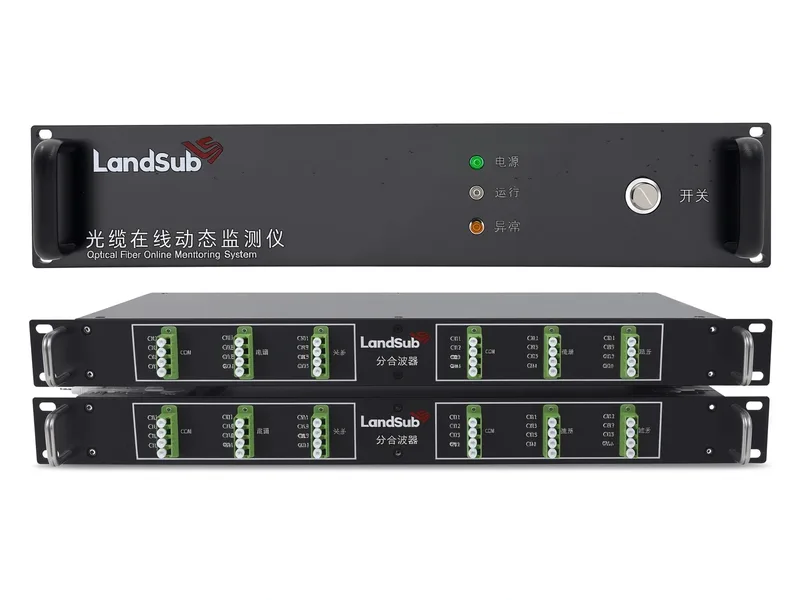
| Monitoring range | 100 km |
|---|---|
| Fault location | ±1 m |
| Model | Pay-per-use / short-term |
Applications: distributed acoustic and temperature monitoring scenarios
Short-term monitoring
Project-based monitoring without upfront hardware cost.
Data operations
Managed monitoring data and alarm analysis.
Cable health
Communication cable health assessment.
Rapid deployment
Fast setup for temporary scenarios.
Short-term service vs. a conventional permanent installation
| Aspect | Permanent self-operated installation | Short-term service |
|---|---|---|
| Upfront commitment | Full hardware, integration and staffing investment | Pay per use, no capital purchase |
| Time to first data | Procurement and integration schedule | Portable hardware on the existing fiber route |
| Data operations | Operator builds its own analysis workflow | Alarm analysis and reporting managed by Landsub Global |
| Best used for | Long-term protection of high-consequence assets | Trials, investigations, temporary and campaign monitoring |
The two models are complementary: a short-term engagement often precedes a permanent installation decision.
Long-distance coverage, rapid setup: how the service works
Each engagement follows a simple, quote-based path from objective to report — the same survey discipline that governs permanent projects, scaled to a bounded scope.
- Step 1 — Objective definition and site survey. The monitoring objective — cable health assessment, incident investigation, trial — is agreed, and engineers survey the route and fiber availability.
- Step 2 — Configuration and quote. Scope, duration and outputs are proposed based on the survey, and the engagement is quoted as a package.
- Step 3 — Equipment deployment. Portable monitoring hardware is installed at the site and connected to the fiber route; existing services are not interrupted.
- Step 4 — Monitored operation. The system runs for the agreed period with 100 km range coverage, while Landsub Global handles monitoring data and alarm analysis.
- Step 5 — Report and handover. The engagement closes with a findings report and, where relevant, a recommendation on whether a permanent installation makes sense.
Where the service fits — measurement scope and boundaries
The service model is designed for bounded engagements with a defined question to answer — not as a substitute for permanent protection of critical assets. Where the answer points toward long-term coverage, the same platform and configuration carry straight into a permanent installation.
- Good fit: pre-purchase trials on a real route, post-incident investigations, periodic cable health assessments, construction-adjacent monitoring windows.
- Good fit: operators who want field data from their own asset before committing to a permanent DAS/DTS/RFTS installation.
- Boundary: coverage is limited to the cabled route and the agreed period; results reflect the monitored window, not long-term statistics.
- Not a fit: assets that need continuous year-round protection — those are better served by a permanent Landsub Global system.
- Transition path: when a trial proves the case, the route survey, baseline data and alarm configuration from the service engagement feed directly into the permanent installation design.
- Scope note: the service uses the same in-service monitoring platform as the permanent RFTS product — 100 km range and ±1 m fault location — with no simplified "trial grade" hardware.
Frequently asked questions
Typical engagements: detection, fault location and assessment
The service model flexes across a range of situations where the question is bounded and the answer has a deadline — each engagement is scoped, quoted and closed with a deliverable.
- Pre-purchase trial: run the sensing platform on a representative section of your own route and evaluate real alarm quality, localization and data output before any capital decision.
- Post-incident investigation: deploy monitoring over a defined window after an event — a cable fault, a third-party strike, a suspected leak — and record the evidence for the investigation report.
- Cable health assessment: a scheduled OTDR-based assessment of communication cable routes, producing fault locations and degradation trends across the network.
- Construction-adjacent monitoring: protect a live cable or pipeline while third-party construction works pass along the right-of-way.
- Campaign support: temporary coverage for pigging runs, commissioning phases or seasonal risk windows, with data operations handled by Landsub Global.
Every engagement uses the same platform family as the permanent products — 100 km monitoring range and ±1 m fault location — so results from a trial translate directly to what an installed system would deliver.
What the deliverables look like
- Monitoring data package: the raw and processed measurement records for the engagement window, delivered in a form your engineering team can re-analyze.
- Alarm and event log: every detected event with timestamp, location along the route and classification — the evidence base for investigations.
- Findings report: a written summary of what the monitored window showed, including any fault locations, degradation trends or intrusion activity observed.
- Follow-up recommendation: an engineering opinion on whether the route justifies a permanent installation, and what configuration would fit.
Because the deliverables mirror the outputs of a permanent system, the engagement doubles as a realistic operational rehearsal: your control-room and maintenance teams see exactly how alarms, localization and reporting would work on this route before any procurement decision.
Related monitoring products: DAS, cable and pipeline
Further reading
- Optical time-domain reflectometer — the measurement technique behind fiber fault location and cable health assessment.
- Fiber optic sensor — background on distributed fiber sensing used across the monitoring platform family.
- Distributed acoustic sensing — how the same platform performs acoustic event detection on a trial route.
- Distributed temperature sensing — the temperature measurement principle available in short-term engagements.
Get a configuration and quote
Tell us your scenario — we'll provide a tailored recommendation.
Last updated: September 2026
By the Landsub Global Engineering Team