
Pipeline Third-Party Intrusion & Leak Detection (DAS)

One fiber becomes tens of thousands of acoustic sensors — 160 km (dual channel) with industry-leading simultaneous listening points, delivering 24/7 third-party intrusion and leak early-warning for linear assets.
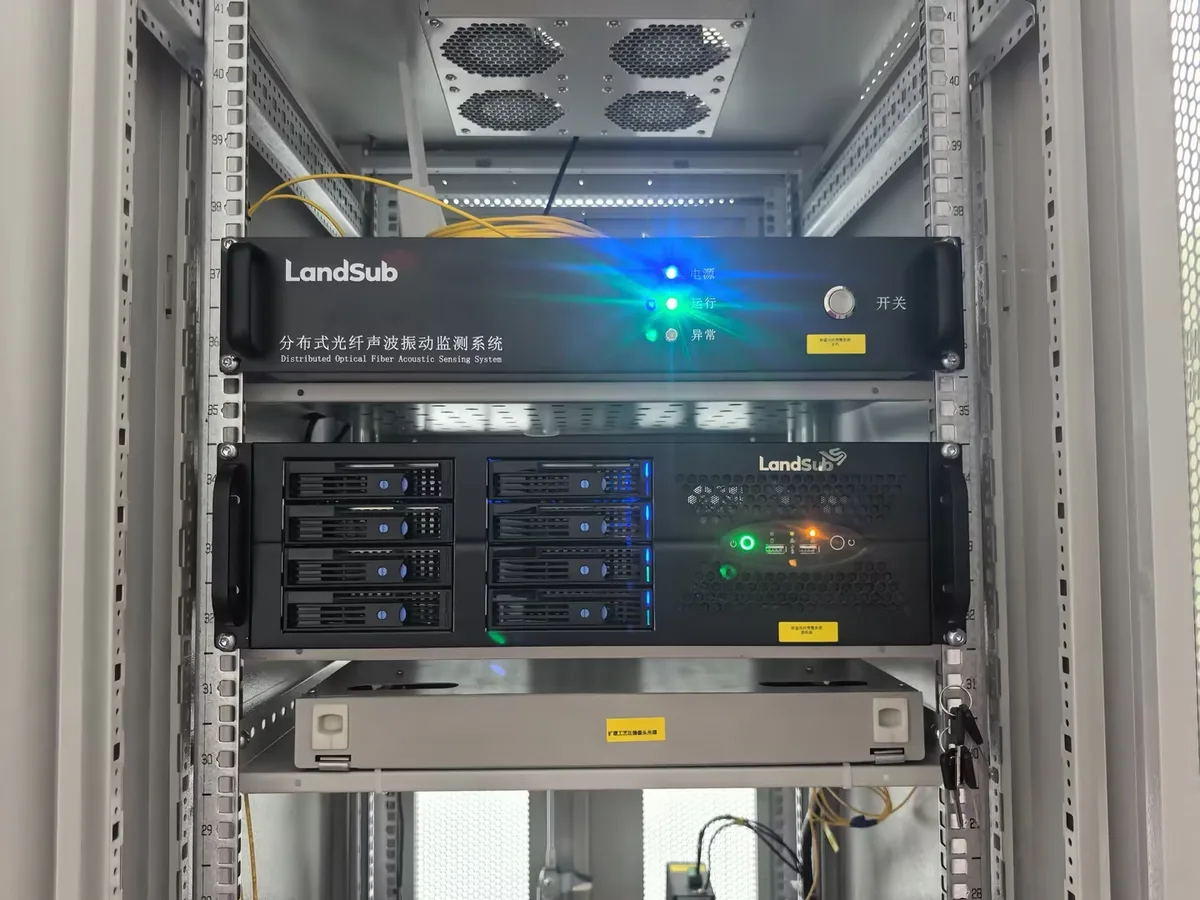
DAS system rack installation
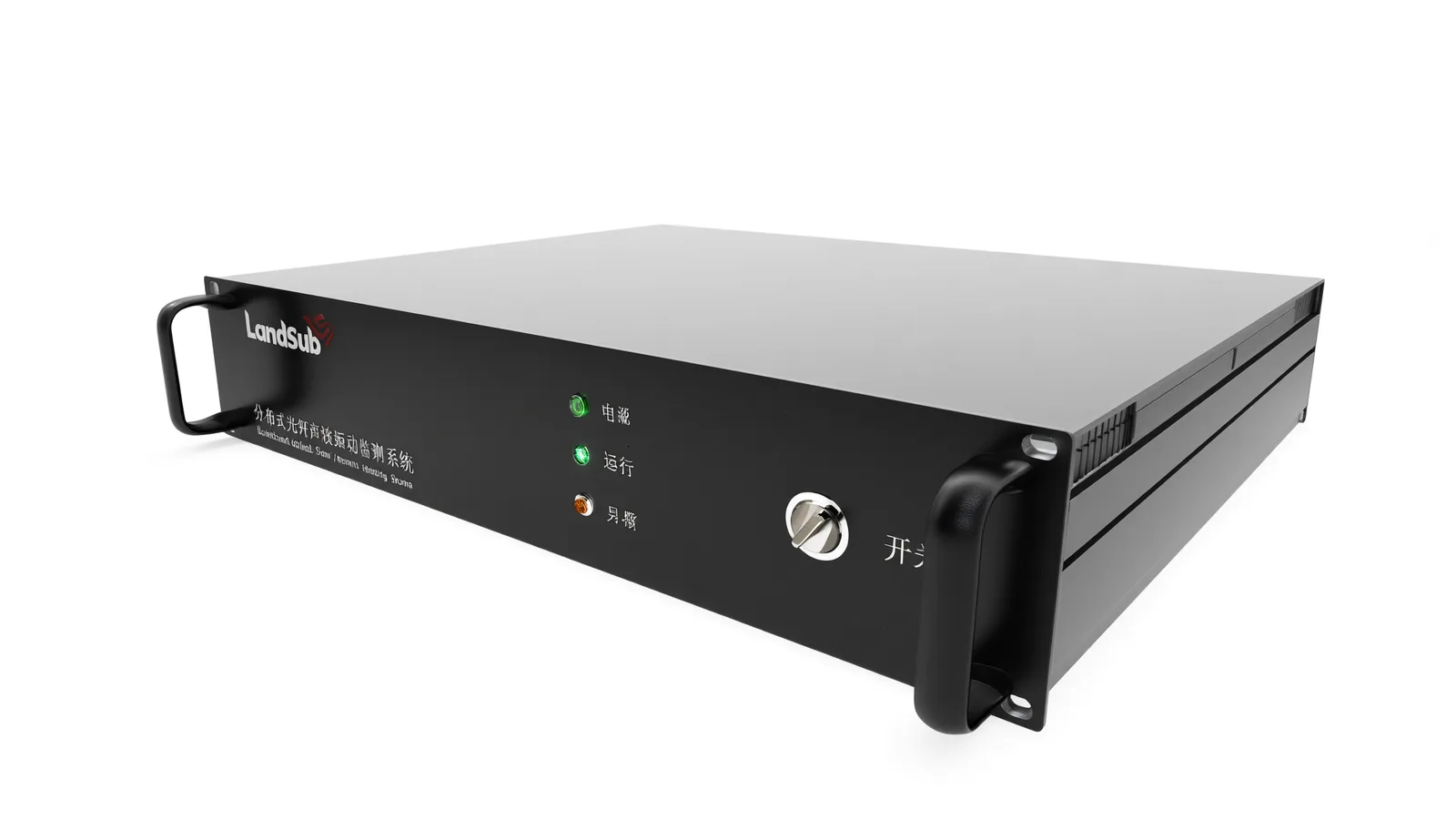
DAS main unit render
DAS main unit (render)
Overview

What is Distributed Acoustic Sensing (DAS)?

Distributed Acoustic Sensing (DAS) is a fiber optic sensing technology that uses phase-sensitive optical time-domain reflectometry (Φ-OTDR) to turn a standard optical fiber into a continuous array of acoustic and vibration sensors. A DAS interrogator launches laser pulses into the fiber and analyzes the Rayleigh backscattered light, so every meter of cable becomes a listening point — with no field power, no separate sensor units and no electronics along the route. The system detects, localizes and classifies vibration events such as excavation, drilling, vehicle movement, leakage flow and third-party intrusion in real time, giving operators a continuous early-warning layer over pipelines, power corridors, railways and conveyor assets.

  • 160 km monitoring reach in dual-channel configuration (86 km per channel in single-channel application terms)
  • ±2 m event localization accuracy along the full route
  • 0.03 rad/√Hz phase detection sensitivity
  • Sensing-communication fusion — one fiber core carries both data communication and acoustic sensing
  • In-house AI event classification, field-verified with effective alarm rates above 95%
Specifications

Key specifications — benchmarked against leading international vendors

DAS key specification comparison
SpecificationLeading international vendors*Landsub Global
Monitoring range100 km (dual channel)160 km (dual channel)
Localization accuracy1–5 m (spatial resolution)±2 m
Sampling frequency1–20 kHz0.1 Hz – 20 kHz
Detection sensitivityNot publicly disclosed0.03 rad/√Hz

*Based on publicly available specifications of leading international DFOS vendors, as of Aug 2026.

Highlights

Technology highlights: interrogator sensitivity and accuracy

📏

Ultra-long single channel

86 km per channel reduces repeaters and host placement, lowering total cost of ownership for long-haul pipelines.

🎯

AI recognition

In-house acoustic AI classifies excavators, farming machinery and manual activity with 99.32% objective accuracy in field evaluation.

🛡️

Field-proven replacement

Replaced a leading global vendor after a multi-vendor field trial on a high-sulfur gas pipeline — 100% on-site recognition accuracy.

Applications

Applications — from excavation to interference, hear it before it happens

Third-party intrusion

Real-time warning and precise localization of mechanical excavation and manual digging.

Pipeline leak detection

Leak acoustic signature recognition with second-level response.

Conveyor roller monitoring

Acoustic fault early-warning for mining and port conveyor rollers.

Rail intrusion & slope

Online monitoring of rail intrusion, slope movement and rockfall.

Deployment

Installation and commissioning: how DAS deployment works

Every Landsub Global DAS project follows a structured, survey-first deployment path, so the monitoring design is based on measured site conditions rather than assumptions.

  1. Step 1 — Site survey and route assessment. Engineers walk the asset route and review cable availability, fiber type, distance budget and threat profile to confirm which sections a DAS unit can cover and where the interrogator should sit.
  2. Step 2 — Fiber qualification and route testing. The selected fiber core is tested for attenuation and backscatter quality to verify it supports the planned monitoring distance and event localization.
  3. Step 3 — Equipment installation. The DAS interrogator is rack-mounted at the designated station — typically an existing control room or communication hub — and connected to the spare core. Traffic on in-service fibers is not interrupted.
  4. Step 4 — Commissioning and alarm zoning. The route is divided into alarm zones, sensitivity thresholds are tuned per zone, and localization accuracy is verified against controlled field tests.
  5. Step 5 — AI model adaptation. In-house recognition models are adapted to the site's event classes — for example excavator, drilling and manual digging signatures — using recordings captured along the actual route.
  6. Step 6 — Handover, training and operations support. Control-room teams are trained on the alarm workflow, and the system is handed over with documentation, thresholds and escalation rules in place.
Fit Assessment

Where DAS fits: long-distance monitoring scope and boundaries

DAS is a continuous, route-wide early-warning layer. It performs best on linear assets that already carry fiber and face third-party activity or leak risk along the right-of-way.

  • Good fit: long-haul oil & gas pipelines, high-consequence gas sections, power cable corridors, railway intrusion and slope monitoring, perimeter security, mining and port conveyor lines.
  • Good fit: assets with an existing co-located communication cable or a planned fiber route — sensing runs on a spare core without new in-ground hardware.
  • Requires realistic expectations: DAS detects and classifies vibration and acoustic events; recognition performance depends on soil, burial depth and event signature, and is validated per project rather than claimed in advance.
  • Not a fit: single-point indoor equipment rooms better served by local sensors, assets with no viable fiber route, and consumer or non-industrial applications.

A final operational note: DAS performance is verified per route, not assumed from the datasheet. Soil type, burial depth, road traffic and pipeline product flow all shape the acoustic signature set, which is why every project includes a calibration phase in which the AI models learn the site's own events before the effective alarm rate is accepted. Once commissioned, the system runs continuously; day-to-day operation is a matter of reviewing the classified event stream, and periodic re-validation after construction or corridor changes keeps recognition aligned with the route as it evolves.

Related Cases

Proven by field projects: detection accuracy in service

Field Verified

PetroChina high-sulfur gas pipeline

Replaced a leading global vendor after a multi-vendor field trial; 100% event recognition accuracy.

100%
Recognition accuracy (test)
Long-haul Pipeline

National operator — China-Myanmar line

59.14 km gas spur line; excavator 25 m, farming 5 m, manual 2 m alarm ranges.

95%
Effective alarm rate
CCUS

PetroChina CCUS CO₂ pipeline

First CCUS CO₂ long-haul pipeline third-party intrusion and leak early-warning system.

1st
CCUS CO₂ pipeline application
FAQ

Frequently asked questions

DAS uses Φ-OTDR and Rayleigh backscattering to turn a whole cable into a continuous acoustic sensor array, monitoring vibration and acoustic events in real time. Landsub Global's DAS reaches 86 km per channel with industry-leading simultaneous listening points.
When excavation occurs along a pipeline, vibration travels through soil to the co-located cable; the DAS unit demodulates it in real time and AI classifies the event and threat level, issuing an alarm with meter-level localization within seconds. Field projects have verified effective alarm rates above 95%.
Usually not. Linear assets often already have co-located communication cables; DAS can use a spare fiber core. Sensing-communication fusion lets a single core carry both communication and sensing.
Learn More

Further reading

Get a DAS configuration and quote

Tell us your pipeline length and scenario — we'll provide a tailored recommendation.

Request a Quote

Last updated: September 2026

By the Landsub Global Engineering Team