
Tunnel & Bridge Structural Health Monitoring (DTSS-BOTDR)
±5με strain accuracy and ≤1 s measurement, providing structural health monitoring for tunnels, bridges and large infrastructure.
What is DTSS-BOTDR?
DTSS-BOTDR is a distributed temperature and strain sensing system based on Brillouin optical time-domain reflectometry (BOTDR), built for structural health monitoring of tunnels, bridges, slopes and other large infrastructure. A single optical fiber bonded to or embedded in the structure acts as a continuous strain and temperature sensor: the interrogator measures the Brillouin backscatter frequency shift at every point along the fiber, converting it into distributed strain data with ±5 με accuracy and an 8000 με measurement range, with a complete measurement cycle of ≤1 s. Instead of a handful of spot gauges, engineers see the full strain distribution of the structure, so deformation trends and anomalies are localized and tracked over time.
- ±5 με distributed strain accuracy
- 8000 με strain measurement range — covers high-strain structural events
- ≤1 s measurement time for near-real-time monitoring
- One fiber, two physical quantities — strain and temperature measured along the same line
- Survives the environment — fiber is immune to EMI and suitable for damp, electrically noisy tunnels and substations
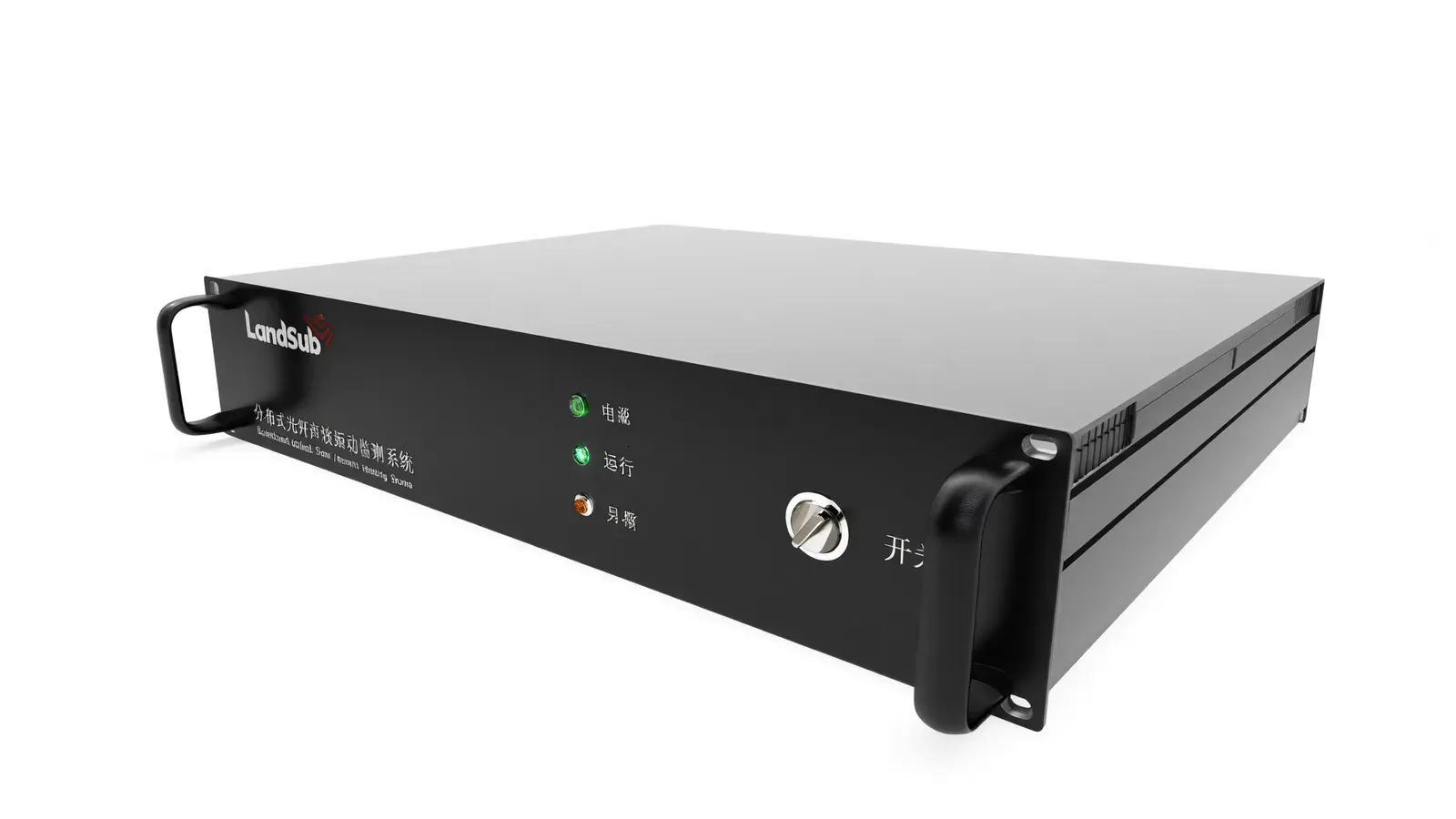
| Specification | Leading international vendors* | Landsub Global |
|---|---|---|
| Strain accuracy | 4 μm/m | ±5 με |
| Strain range | Not disclosed | 8000 με |
| Measurement time | 0.1–10 s | ≤1 s |
| Range | 100 km | — |
*Based on publicly available specifications of leading international DTSS/DSS vendors, as of Aug 2026.
Applications
Tunnel monitoring
Structural strain and temperature monitoring of tunnels.
Bridge monitoring
Deformation early-warning for bridges.
Slope monitoring
Distributed strain along slopes and retaining structures.
Foundation monitoring
Settlement and strain tracking for foundations.
How DTSS-BOTDR deployment works
Structural monitoring projects begin with the structure's mechanics — the sensing layout follows where strain is expected to develop, and every design decision is documented so the data collected over years remains comparable to the baseline.
- Structural review and sensor layout design. Engineers study the tunnel, bridge or slope geometry and its expected deformation modes, then define where the sensing fiber should be bonded along rings, girders or anchor lines.
- On-site survey and routing check. Fiber paths, splice points and the interrogator location are surveyed against site access, cabling distance and environmental conditions.
- Fiber installation and bonding. The sensing fiber is fixed to the structure at the designed positions; installation method is chosen to transfer structural strain to the fiber faithfully.
- Interrogator installation and commissioning. The DTSS-BOTDR unit is installed at the monitoring station, and the full fiber is verified end to end.
- Baseline and alarm configuration. An initial strain/temperature baseline is recorded, alarm bands are set per zone, and data is linked to the operator's monitoring platform.
- Handover and trend reporting. Operations teams are trained on reading distributed strain trends, and periodic review of the structural data begins.
Where DTSS-BOTDR fits — and where it does not
DTSS-BOTDR addresses a specific question: how is a long structure deforming over time? It is the right tool when strain distribution matters more than isolated spot readings, and when the answer must stay measurable against the same baseline year after year.
- Good fit: tunnel linings, bridge girders and decks, retaining walls and slopes, foundations — structures where deformation may appear anywhere along the line.
- Good fit: EMI-heavy and damp environments where electrical strain gauges degrade, because the fiber sensor is passive and immune to interference.
- Long-term trend focus: the system is designed for continuous structural health trends; sudden dynamic impact events are better served by complementary DAS monitoring.
- Data continuity: because the sensing line is passive, measurements keep flowing through environments where electrical instruments drift, corrode or fail.
- Not a fit: small structures where a few spot gauges suffice, projects with no feasible fiber routing, and non-industrial applications.
- Validation first: bonding methods and baseline expectations are confirmed against the structure's design documents, so alarm bands reflect engineering significance rather than generic values.
Frequently asked questions
How BOTDR turns strain into data
The measurement principle is Brillouin backscatter: when a laser pulse propagates through the fiber, the frequency of the backscattered Brillouin light shifts in proportion to the strain and temperature at the scattering point. The DTSS-BOTDR interrogator resolves this frequency shift at every position along the fiber, separating the strain contribution from the temperature contribution, and reports both as continuous distributed profiles. Because the fiber is a passive dielectric line, the measurement keeps working where electrical instrumentation struggles — high-voltage environments, damp tunnels, long-term buried installations — and because one fiber covers the whole structure, the data shows not just that deformation is happening but where along the structure it is developing.
- Distributed strain profile: ±5 με accuracy at every measurement point, with an 8000 με range that accommodates significant structural deformation events.
- ≤1 s full-profile measurement: fast enough to track how strain redistributes during operation, not just long-term averages.
- Trend tracking: baselines recorded at commissioning allow gradual settlement, creep or settlement-induced strain growth to be quantified over time.
- Zone-based alarm bands: critical sections of the structure carry tighter thresholds than reference zones, matching the engineering significance of each area.
Get a configuration and quote
Tell us your scenario — we'll provide a tailored recommendation.
Last updated: September 2026